
Prof Lynne Shannon Makes History as First Global South Recipient of the Prince Albert I Grand Medal for Ocean Science
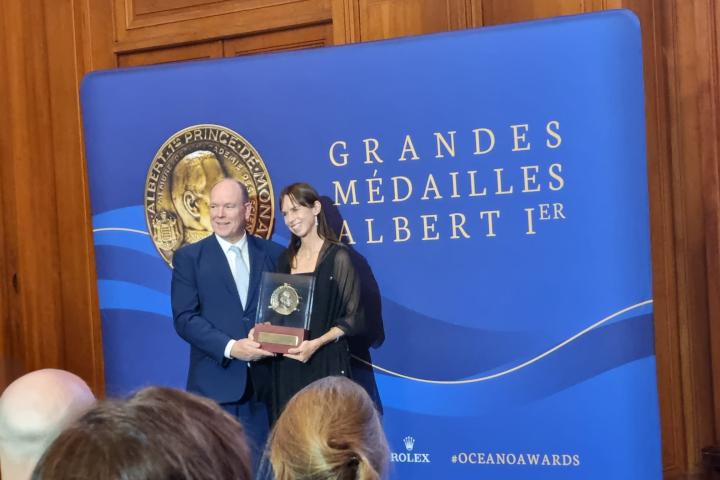
On 8 December 2025, in the historic halls of the Oceanographic Institute in Paris, South African marine scientist Prof Lynne Shannon—Deputy Director of UCT-MARiS and Research Professor in the Department of Biological Sciences at the University of Cape Town—was awarded the Prince Albert I Grand Medal for Ocean Science, becoming the first recipient from South Africa and the broader Global South to receive this distinguished international honour.
As the 2025 Laureate for the Grand Medal (Science), Prof Shannon is recognized as a highly qualified oceanographer whose lifetime contributions, seminal discoveries, and leadership in marine ecosystem science have had global impact. The Science category honours individuals whose work has profoundly advanced the field of oceanography.
The Prince Albert I Grand Medal—established by the Oceanographic Institute to honour its founder, Prince Albert I of Monaco, a pioneer of modern oceanography—is one of the world’s most prestigious prizes in marine science. It recognizes lifetime excellence, transformative discoveries, and scientific leadership that strengthen humanity’s understanding of the ocean. Laureates are selected through an international process involving the Institute’s Scientific Council and its Board of Directors, and past recipients include leading global oceanographers whose work has shaped marine conservation and policy worldwide.
Prof Shannon’s recognition places South African marine science firmly on the world stage, reflecting decades of excellence in research, policy development, and international collaboration. For the University of Cape Town, the Marine and Antarctic Research for Innovation and Sustainability (MARiS) Centre, and the national marine science community, this achievement signals a moment of immense pride and global acknowledgement.
A Prestigious 65-Year Ceremony Honouring the Ocean’s Greatest Contributors
The prizegiving ceremony is more than a formal event—it represents a 65-year tradition of global recognition. Since 1948, the Oceanographic Institute has been internationally acknowledged for its legitimacy and authority in honouring leading figures in ocean science, conservation, and public engagement.
The ceremony’s prestige is reflected in the calibre of its past recipients. Public-facing laureates in the Mediation Category include Jacques-Yves Cousteau (1981), Leonardo DiCaprio (2015), Erik Orsenna (2016) and Dame Ellen MacArthur (2018)—individuals whose influence has shaped global ocean awareness.
In the Science Category—the category in which Prof Shannon is now honoured—past awardees include distinguished oceanographers such as Shubha Sathyendranath (2013), Prof Daniel Pauly (2016) and Prof Lisa Ann Levin (2019), each renowned for groundbreaking contributions to marine research.
Prof Shannon now joins this exceptional lineage, marking a historic first for South Africa and the Global South.

A Career Defined by Excellence, Collaboration and Vision
With more than 30 years of ecological research, over 180 peer-reviewed publications, and long-term leadership in ecosystem-based management, Prof Shannon has played a central role in shaping scientific understanding of marine food webs in South Africa and Namibia. Her work has informed fisheries policy, advanced trophic modelling, and contributed to global assessments through the Intergovernmental Science-Policy Platform on Biodiversity and Ecosystem Services (IPBES).
In her award-day interview, Prof Shannon reflected deeply on the significance of South Africa’s scientific partnerships, especially the long-standing French–South African collaborations that played an instrumental role in her journey:
“Just embarking on my PhD, I was enormously privileged to be drawn into a unique French–South African scientific bilateral. It set me on a path of lifelong collaboration, mentorship and discovery, and Paris holds many special memories for me—including my first experience of falling snow during our IndiSeas project meetings at UNESCO.”
This collaboration shaped some of the most influential ecosystem-indicator projects in the world, including the Indicators for the Seas (IndiSeas) initiative, which continues to guide ecosystem-based management in marine systems.
Transforming Marine Sustainability and the Science–Policy Interface
Prof Shannon leads UCT’s Marine Sustainability research team, overseeing work that spans marine ecology, oceanography, fisheries science, human–nature relationships, and conservation decision-making. Her recent focus centres on bringing local perspectives and diverse knowledge systems into global science–policy processes.
She explained:
“Transformative change requires immediate, visionary action—where humans are recognized as part of nature and where diverse knowledge systems are brought together in complementary and constructive ways.”
Her current work explores how disciplines such as law, governance and the arts can intersect with marine science to reimagine how societies engage with the ocean. This represents a growing movement to expand ecosystem-based management into a more inclusive, culturally grounded and socially transformative approach.
Building Partnerships and Empowering Future Leaders
Reflecting on how to unite scientists, world leaders, and civil society behind ocean stewardship, Prof Shannon emphasized the importance of shared purpose:
“We need common goals and common projects that bring diverse actors together—with their talents, knowledge and spheres of influence. Collaboration makes us stronger and more responsive in protecting the Ocean.”
A passionate mentor, she highlighted education and youth development as essential pillars of a sustainable ocean future:
“I aim to make my research lab a haven for dedicated ocean science—where young researchers can test ideas, build skills, and embrace new tools. They bring energy and openness, and I hope to be as much of a springboard for them as my mentors were for me.”
When asked what the ocean needs most urgently, she offered two interlinked priorities:
“Firstly, we need visionary scientists. Secondly, we need people to reconnect with nature and recognize the intrinsic value of the ocean—not just its services. Everyone can play a role; small actions sum to big impacts.”

A Landmark Moment for UCT and South Africa
Prof Shannon’s recognition extends far beyond her individual achievements. It marks a watershed moment for South African marine science, demonstrating the country’s leadership in ocean sustainability, modelling, biodiversity research and science-policy innovation.
Her award affirms UCT’s position as a global contributor to marine and Antarctic science and highlights the success of South Africa’s long-term investments in ecosystem-based fisheries management, interdisciplinary research and international collaboration.
On behalf of the University of Cape Town, UCT-MARiS and the South African scientific community:
We congratulate Prof Lynne Shannon on this extraordinary achievement. Her groundbreaking contributions, visionary leadership and commitment to inclusive, transformative ocean science reflect the excellence and global impact of South African research. We are immensely proud to be associated with such an exceptional marine scientist.

